Selecting the perfect e-commerce platform is critical as it affects your business technology costs, conversion efficiency, and future scalability. In today’s world of digital commerce platforms, two giants rule the roost, WooCommerce and Shopify. Whereas Shopify provides everything you need in a turn-key fashion through its managed SaaS infrastructure designed to scale, WooCommerce is a WordPress plugin that provides complete code ownership and flexibility.
In DigiKnock, we help you solve the architecture puzzles you face. Having knowledge of the significant distinctions between WooCommerce and Shopify ensures that your digital architecture is appropriate to fit in your technology ability, budget, and scalability expectations.
Shopify vs WooCommerce: Which Is Better?
Determining shopify vs woocommerce which is better becomes dependent on nothing else but on your approach, technical capabilities, and plans. Neither of those platforms is absolutely better in all aspects, instead, both of them have totally different approaches.
- Shopify (The Fully Hosted SaaS Powerhouse): Shopify is a software as a service platform dedicated to retail and DTC businesses. You pay a subscription fee every month, log in to the intuitive dashboard and leave everything to take care of the platform itself – server hosting, security certificates, and software updates.
- WooCommerce (The Open-Source Customization King): WooCommerce is an extensible, open-source e-commerce plugin WooCommerce (The Open-Source Customization King): WooCommerce is a flexible, open-source shopping cart plugin running on WordPress platform. It gives you full ownership of all your data and the freedom to manipulate every single element of your shop using the base code. But all that flexibility also means that you will have to pick your own hosting provider, keep everything safe, and keep it up to date.
- The Bottom Line: The best option when it comes to quick development and minimum technical effort is certainly Shopify. If you require maximum content integration, SEO optimization, and full freedom in manipulating back-end code, then go for WooCommerce.
Shopify vs WooCommerce: Which Is More Secure?
Security is one of the main pillars of every online store processing clients’ data and payments.
- Shopify’s Managed Security: Because Shopify is a closed, fully hosted SaaS environment, security is managed centrally by the platform. Every store includes Level 1 PCI DSS-compliance by default, auto SSL certificates, default fraud tools, and regular server-side patches. Vulnerabilities do not need to be patched manually at the server level.
- Security for Self-Managed WooCommerce: WooCommerce is inherently secure in nature, but being run on the self-managed WordPress platform, you have to take the responsibility for the security of your store (your development team will have to shoulder the responsibility). The security of your WooCommerce store entails the selection of a good hosting environment, stringent credential policies, security extensions such as Wordfence and Sucuri, and updating of the plugins and PHP.
- Conclusion: If you prefer a completely secured environment out-of-the-box without a developer, then Shopify is a better option. However, even WooCommerce will work perfectly fine with regards to security along with the high-end managed hosting services.
Shopify vs WooCommerce: Which Is More Popular?
Adoption statistics paint a rather fascinating picture of trust, community size, and maturity of the platforms. In terms of popularity in terms of shopify vs woocommerce, both platforms have enormous sizes of their presence worldwide, although, they cater to different market segments:
- Global Market Share: The reason WooCommerce is able to capture so much market share in the global open-source web world is because it offers perfect integration with WordPress, and this makes it extremely popular in blogs and webstores that contain lots of content.
- Market Leader Based on Traffic Volume: When looking at the top one million most trafficked e-commerce websites globally, Shopify is a leader based on market share.
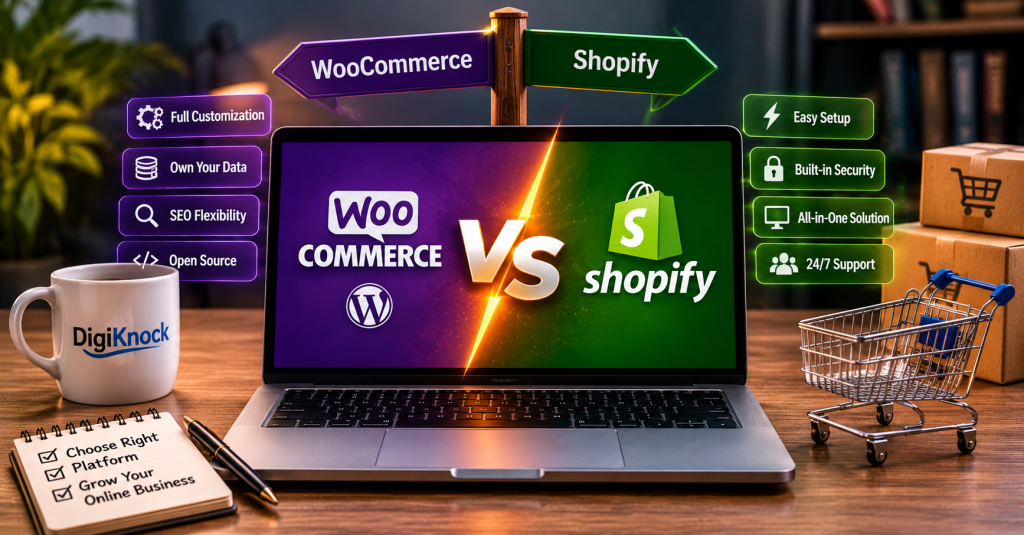
Comprehensive Comparison Table: WooCommerce vs Shopify
To give you a clear, side-by-side view of how these platforms stack up across vital business metrics, review the matrix below:
| Feature / Category | WooCommerce | Shopify |
| Platform Type | Self-hosted WordPress open-source plugin | Fully hosted, all-in-one SaaS platform |
| Global Market Share | Dominates raw site count via WordPress integration | Leads among top high-traffic enterprise stores |
| Starting Cost | Free plugin; web hosting required (~$10–$100/mo) | Subscription-based tiers (starts at ~$39/month) |
| Ease of Use | Moderate; requires WordPress familiarity | High; streamlined setup wizard and user interface |
| Design & Customization | Limitless; full access to HTML, CSS, PHP, and JS | Restricted to theme editor and Liquid template code |
| Security Management | User-managed (hosting, SSL, updates, plugins) | Fully managed by platform (PCI compliant, auto-updates) |
| Transaction Fees | 0% platform fees (only standard gateway processing rates) | 0% with Shopify Payments; up to 2% surcharge for third-party gateways |
| SEO Capabilities | Superior; advanced control via Yoast/Rank Math and custom URLs | Strong out-of-the-box basics; restricted URL formatting (/products/ prefix) |
| Customer Support | Community-driven forums, documentation, and developer networks | Dedicated 24/7 live support via chat, email, and phone |
Making Your Decision
The choice of WooCommerce versus Shopify depends entirely upon your own unique brand’s DNA and technical runway. If you need a stable subscription-based service with no infrastructure issues, no worries, and an optimised checkout process to handle all kinds of ad-driven traffic, Shopify is the way to go. If you demand complete data control, full control of complex content-to-commerce processes, and complete freedom from any transaction costs from your platform, WooCommerce has no equal.
For personalised advice on your brand’s exact needs and goals, connect with us at DigiKnock!