The world of digital marketing seems to be changing beneath us. For many years, the sole goal was getting into the good books of the Google algorithm and landing in the first page of their search results. However, this is no longer the case, as information gathering has changed. With the emergence of new technologies such as the use of ChatGPT and Google’s Search Generative Experience, we are moving into a new era.
To remain competitive, we must know how to play the evolving game of SEO vs. GEO.
What Exactly Is GEO?
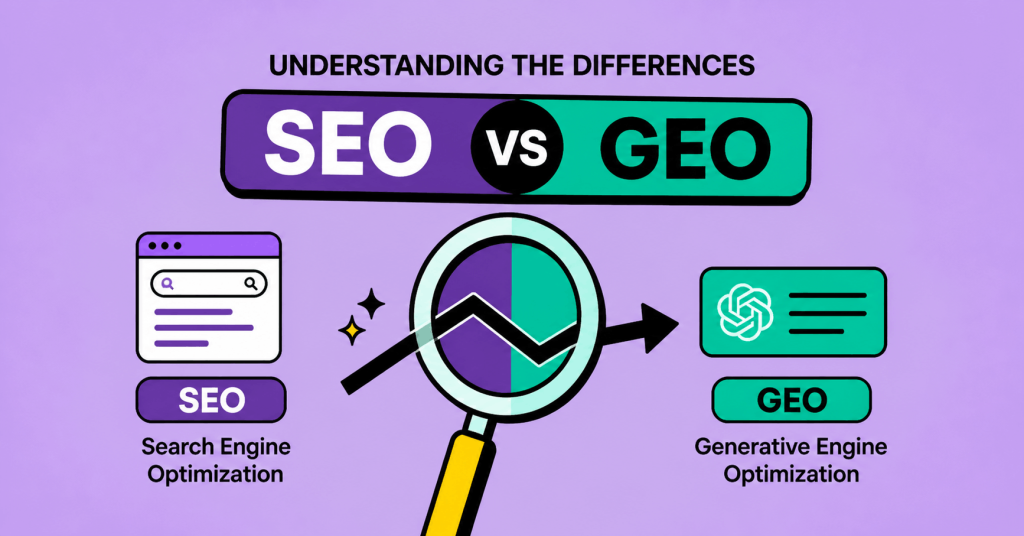
As we look at the landscape of seo vs geo, we see the emergence of Generative Engine Optimization (GEO). This is the practice of optimizing content specifically for AI-powered “generative” engines. Instead of a list of links, these engines provide a synthesized, conversational answer.
GEO is about visibility within the AI’s summary. If an AI tool explains how to start a garden, you want it to cite your website as the source of that information. It calls for an entirely new way of content generation where one should concentrate more on “cite-ability” and conciseness.
What Makes SEO, GEO, and AEO Different From Each Other?
It would be helpful to know the difference between SEO vs. GEO vs. AEO in order to better comprehend the subject matter. AEO belongs to a field that revolves around voice searches and instant answers.
- SEO: Here, the objective is to obtain top rankings in the traditional SERPs (Search Engine Results Pages).
- AEO: The target is to rank first in the Position Zero page.
- GEO: It aims at the conversational summaries of LLMs (Large Language Models).
While they share common goals, the execution varies. SEO cares about your click-through rate, while GEO cares about how often your brand is mentioned as an authoritative source in an AI’s response.
Why is GEO Becoming Necessary for Brands?
Traditional search isn’t dying, but it is sharing the stage. Many users now prefer getting a direct answer rather than browsing five different websites. If your content isn’t optimized for these generative engines, you risk losing a massive chunk of “top of the funnel” awareness. Professional generative engine optimization services help brands adapt by restructuring data.
Key Factors for Ranking on AI Engines
In order to succeed in the new era, you have to utilize both aspects of your strategy. While ignoring the technical side would be unwise, you have to focus more on the “source.”
- Sources of Credible Information: Facts make AI work more efficiently. Back up your claims with hard numbers and credible sources.
- Data Structure (Schema): Make it easy for bots to understand your information.
- Direct Answers: Answer the question in the heading first.
- Brand Authority: Mention your expertise. AI engines prefer citing “entities” (people or brands) that have a proven track record in their niche.
Can Traditional SEO Still Help You?
Absolutely. You shouldn’t throw away your old playbook. When debating seo vs geo, one should never forget that geo is essentially constructed on the foundations laid down by seo. If your website does not have good technical fundamentals or any kind of authority whatsoever, then AI will likely not be interested enough to create a summary from your content.
What About E-commerce?
In terms of e-commerce websites, this change in algorithms means something else entirely. If a customer asks an AI for the best waterproof hiking boots, then AI will search through reviews, product descriptions, and blogs.
To ensure that this doesn’t become a problem, consider hiring dedicated e-commerce SEO services. This includes optimizing product feeds, encouraging detailed customer reviews, and creating “buying guides” that clearly explain the pros and cons of your inventory. If the AI can see your product is highly rated across the web, it is much more likely to recommend it in a generative summary.
The Role of User Intent in Modern Strategy
One of the biggest differences in the seo vs geo comparison is how we view “intent.” Traditional search often focuses on specific keywords. When someone asks, “How can I repair a dripping tap?”, they expect instructions.
When someone else asks, “Why is my tap dripping?”, they expect an analysis. It is imperative to have content that is smart enough to address both aspects, giving instructions for the how-to and the why in one single piece.
Is AI Search Going to Replace Google?
It is more likely that Google will continue to become an AI engine itself. We are already seeing this with the integration of AI Overviews. This means you don’t have to choose between seo vs geo—you have to do both simultaneously.
The goal is to appear in the AI overview at the top and in the organic links below. This “double-dip” strategy maximizes your real estate on the screen and builds double the trust with the user.
Measuring Success in the New Search Era
We used to measure success by “Rankings” and “Clicks.” In the GEO world, we have to look at “Impressions” and “Brand Mentions.” If an AI mentions your brand three times in a day to different users, that is a win, even if they don’t click through to your site immediately.
New Metrics to Watch:
- AI Citations: How often is your URL cited in generative answers?
- Sentiment Analysis: Does the AI say something good or bad about your brand?
- Voice Search Share: What percentage of your content is used by people during “hands-free” searches?
Staying Ahead of the Game
The AI models get trained on the new data all the time. If your facts are from five years ago, the generative engine will probably choose another source to use in its response. It’s better to invest in generative engine optimization services now than wait until the algorithm changes. Be ready for tomorrow’s innovations in search engines today.
Concluding Remarks on the Future of Search
SEO vs. GEO debate has only started. With time, technology will change our approaches. If you manage to combine the power of SEO with the influence of GEO, you can make your digital presence “future-proof”. No matter how people use their smartphones to ask questions (voice search, text, or AI).